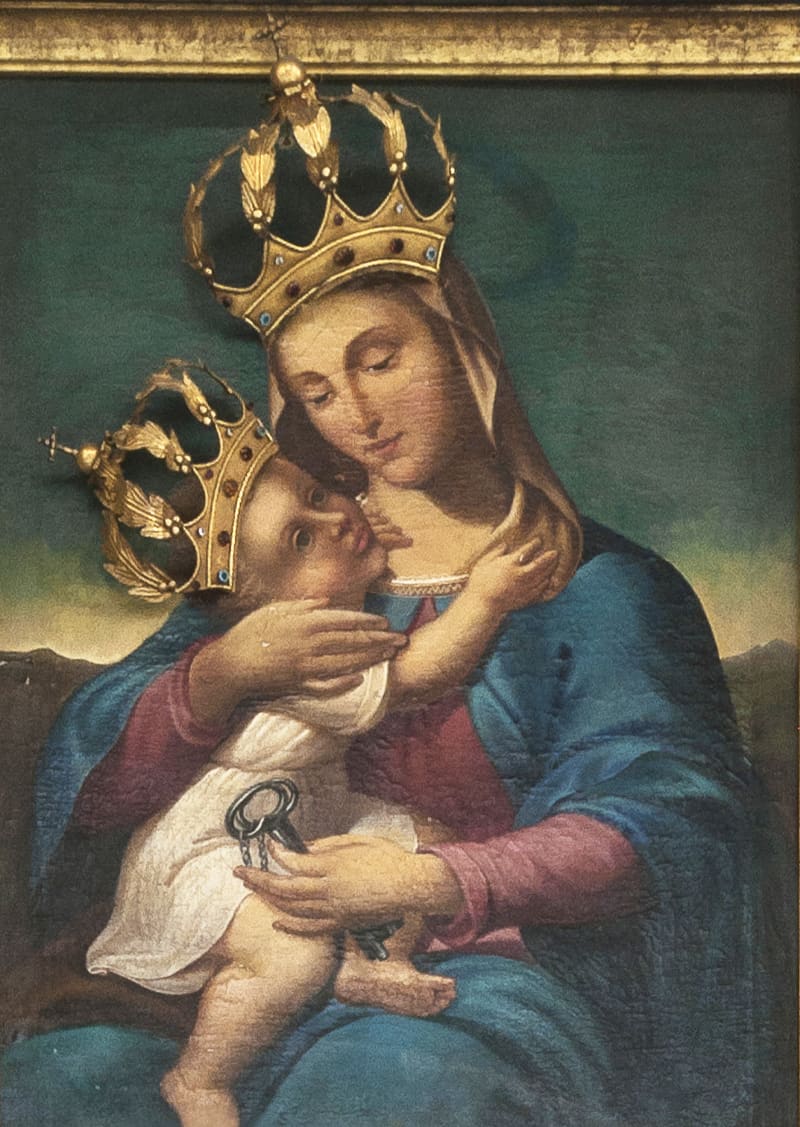
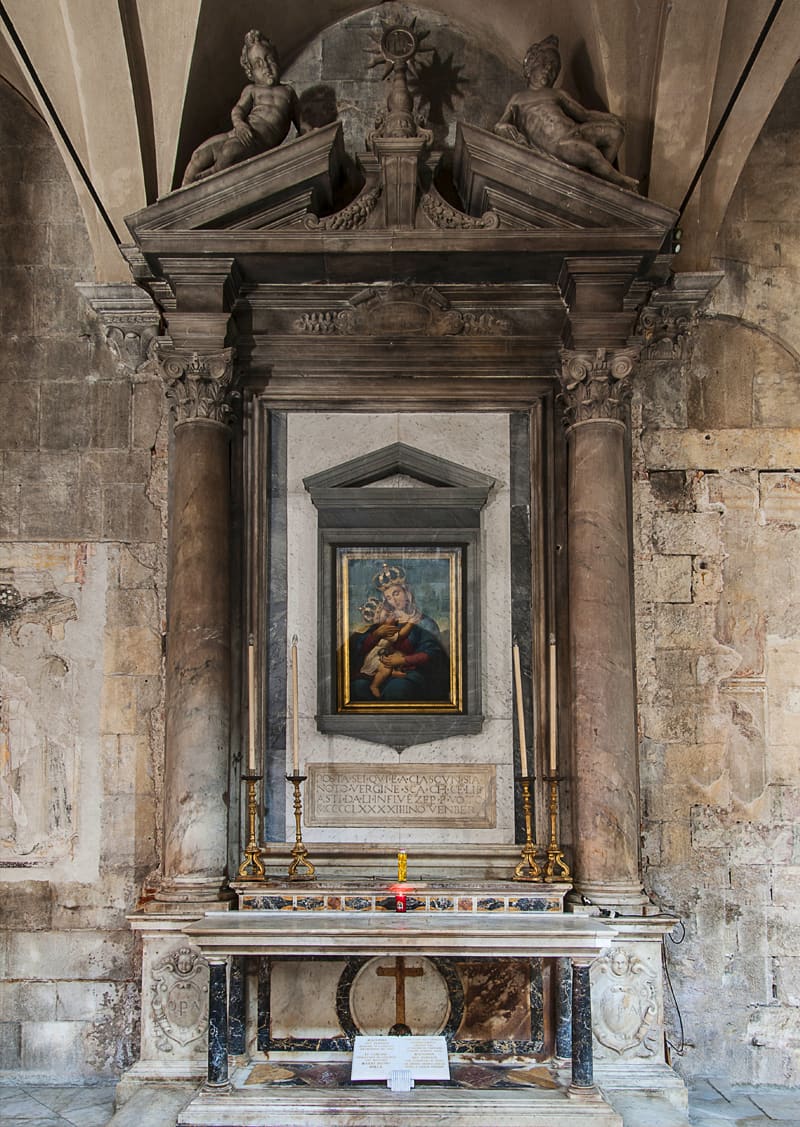
Altar of the Virgin of the People
Altar from the XVI century – painting on canvas from the XIX century
The devotion to Mary was connected to the walls of Carrara. Both on the late medieval walls, and on the ones from ‘500, the request of protection to the Virgin is evident.
The Ghibelline Door was built in the XIII century, at the end of the road bearing the same name that still today leads to the Cathedral. The image of Mary was situated on the door: Mary, Porta cœli, was placed to indicate the entrance and to welcome the prayers of those who left.
In 1495, Carrara was close to being sacked by the troops of Carl VIII, that had already destroyed great part of Lunigiana. The people of Carrara asked for protection to the Virgin of the Ghibelline Door: “miraculously” the troops spared the city.
Since then, the sacred image has been worshipped and recalled with the name of “Virgin of the People”. The door was torn down when the walls of Carrara were expanded, (1632) and the miraculous image was moved to the Cathedral.
The image currently safeguarded in the altar of the Cathedral isn’t the original one. Unfortunately, the reasons of the disappearance are not fully clear: it was probably due to a theft. It isn’t clear if it was a fresco or a bas-relief.
There is an engraving, by Giuseppe Livi, professor of the Academy of Fine Arts of Carrara, that was inspired by the image of the Ghibelline Door, of which also copies exist on medals and bas-reliefs held by noble families from Carrara. The tagline reports as follows: Miraculous image of the Virgin of the People that is worshipped in the Insigne Collegiata Church and parish of St Andrew Apostle of Carrara, engraved once again in the year 1850 by the administrators. Giuseppe di Vincenzo Livi designer Ferd. Grassini engraved in Pisa.
The current image of the Virgin of the People (fig.6) is an oil on canvas by Angelo Sassella who taught at the Carrara Fine Art Academy from 1866 to 1892. Below the artwork there is a marble epigraph, an authentic piece from the Ghibelline portal, inscribed:
”POSTA SEI QUI E A CIASCUN SIA/ NOTO VERGINE SCA CH CE LIB/ASTI DA LE INFLUENZE P.P.co VOTO/ MCCCCLXXXXIIII NOVEMBER
(“You are placed here and let everyone know, Sacred Virgin, that you freed us from pestilences. By popular vote. November 1494”)