The Bell Tower
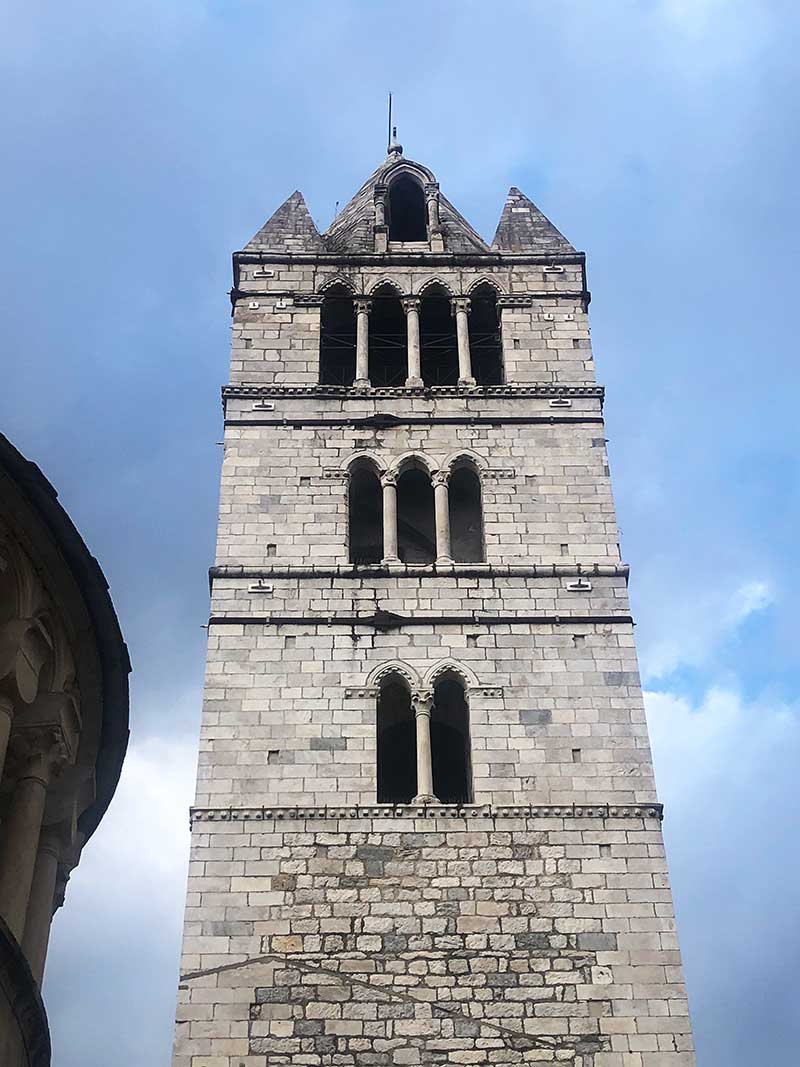
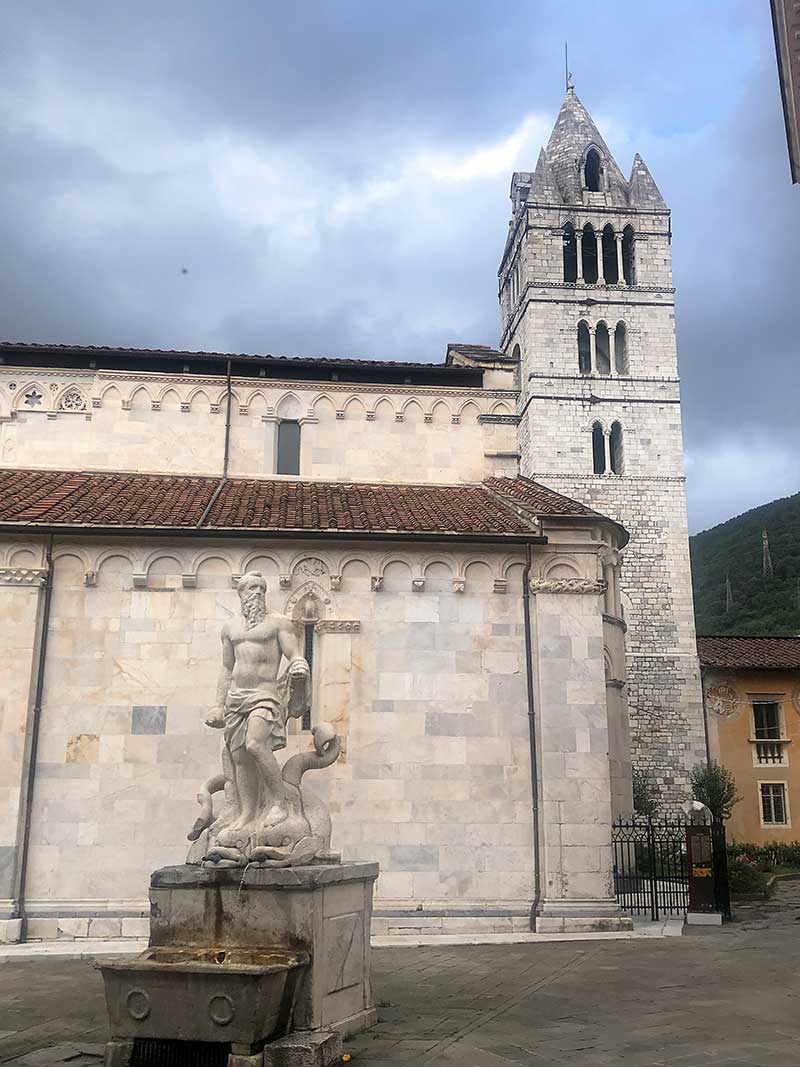
In the apse area rises the majestic structure of the bell tower. Built entirely from marble blocks starting in the late 1100s, it essentially follows the stylistic features of the Abbey while showing some Ligurian influences. Its construction took place in two distinct periods, which can also be deduced from the different types of marble blocks used: rough and unshaped at the base, while worked and squared in the upper part.
The tower is divided into five levels, each featuring different types of windows. On the first level, for structural reasons, there is only a narrow slit, which then becomes a fully rounded Romanesque arch window on the second level. Below this, a spear with a date is carved. According to one theory, it might be a trowel, attributed to the symbol of the master builders.
However, it is more likely a clear reference to Azzolino Malaspina dello Spino Fiorito, known as “the Lancia” (the Launcher), who ruled Carrara in the 13th century, particularly around 1282, when the work on the bell tower was completed.
On the third and fourth levels, the tower features double-arched and triple-arched windows with Gothic-style arches supported by elegant columns with claws at their base and intricately carved
capitals. The top floor has large four-arched windows supported by well-finished columns.
The bell tower is topped with an octagonal-based pyramid made entirely of marble, flanked at the four corners by smaller square-based spires. The main spire is interspersed with Gothic-arched
windows, supported by pairs of columns. At the very top, a finely crafted marble cross crowns the structure.
The interior of the tower is hollow, with a long staircase made of solid marble steps, inserted directly into the blocks and extending all the way to the top of the tower. The center serves as a
passage for the ropes that once ran down to the base and were used to ring the bells. Even today, the worn-out holes in the marble can still be seen, marking the paths where the ropes once ran.
On the fifth level, there is the belfry, which houses the “castello” and a set of four bells. Below the belfry, in a chamber closed by a door that allowed access only to authorized personnel, the ancient mechanical clock can still be found.