
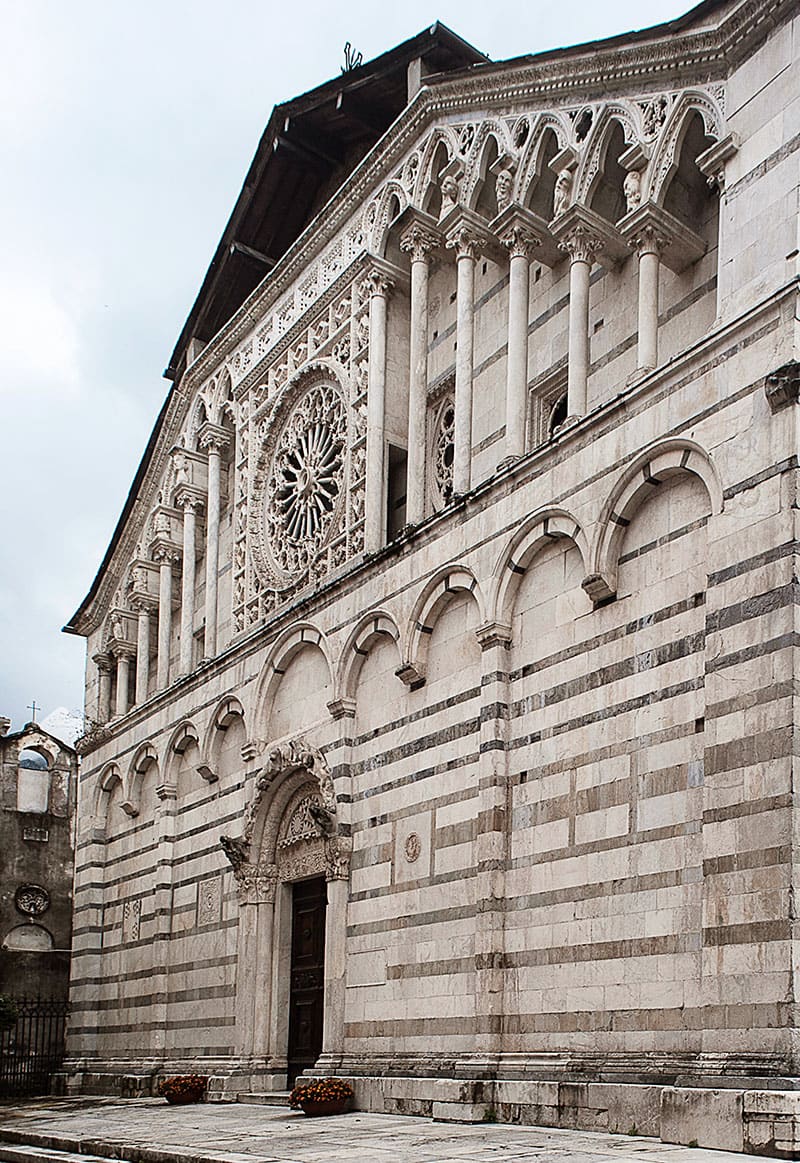
Facade
Of the entire cathedral building, of which the earliest historical records date back to the end of the X century, the façade is the one in which it is easiest to chronologically find the interventions of the various centuries. In this temple dedicated to Saint Andrew, one of the few built entirely in marble, the building interventions denote the strategic position of the city of Carrara, a crossroads between north and south, a passageway on the Via Francigena, a place to stop and approach the quarries of white marble, extracted since the time of the Roman Empire.
The basal part is in the Romanesque style and sees alternating local marbles of different colours: in fact, in the marble basins, in addition to the well-known white marble, many varieties of marble are extracted, up to the entirely black marble. This basal base echoes the style of the Lucchese churches and can be dated to the XII century.
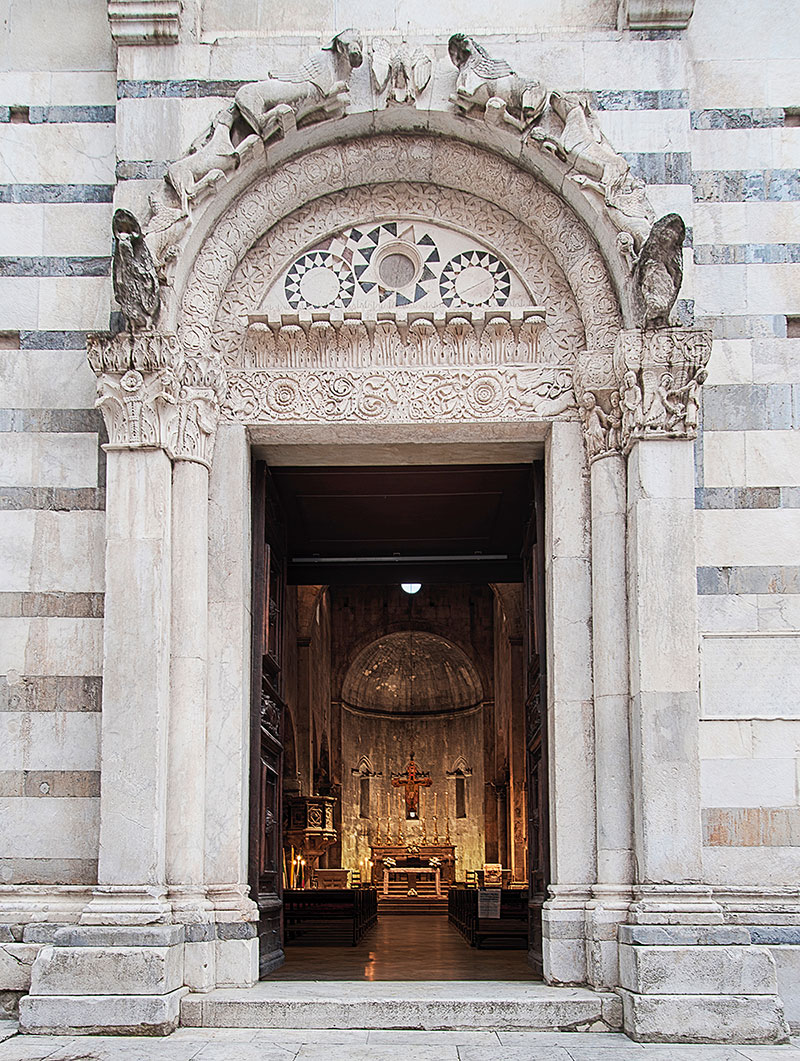
Of the same period but of a different authorship is the portal, certainly involving Niccolò di Wiligelmo and his school, active in Parma and Emilia. Rich in symbols with real and imaginary animals, faces and plants recalling the Garden of Eden, its delights and mystery, the capital on the right is particularly interesting because it tells the story of Abraham the father of Faith.
In the first decades of the 1100s, the portal became the model for several portals in Corsica, and continued to amaze travellers and pilgrims for centuries; in the early 1800s, for example, it was the object of attention and study of the British poet and engraver William Blake. The basal part is rich in panels with meanings that are still partly to be deciphered, in particular the Trinity and probably Templar crosses can be found along with several tombstones.
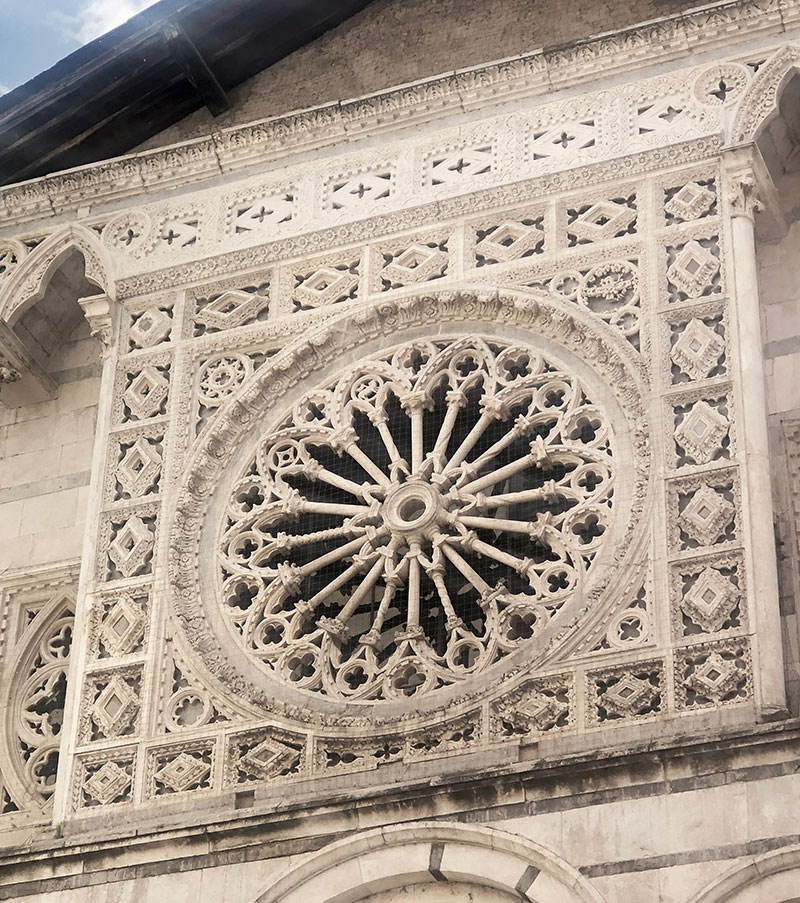
The upper part of the façade, on the other hand, was built in the XIV century and is characterised by the presence of the magnificent rose window inscribed within a square whose sides are formed by a frame of finely carved, perforated rhombi. In the rose window and in the fourteen columns in descending order surmounted by Corinthian capitals, which support corbels with finely sculpted heads, one can fully find the Gothic style prevalent in the city of Pisa, at that time engaged in one of the largest and most astonishing projects ever realised, namely Piazza dei Miracoli.
The façade is believed to have been unfinished with another colonnaded floor, a solution adopted in other Tuscan churches, in particular the similar Santa Caterina d’Alessandria in Pisa. Lucca, Pisa and Parma are found in our façade, which therefore expresses the identity of our city located on the border of different states close to the Apuan Alps that have always been visited by the best sculptors and builders of all times
South facade
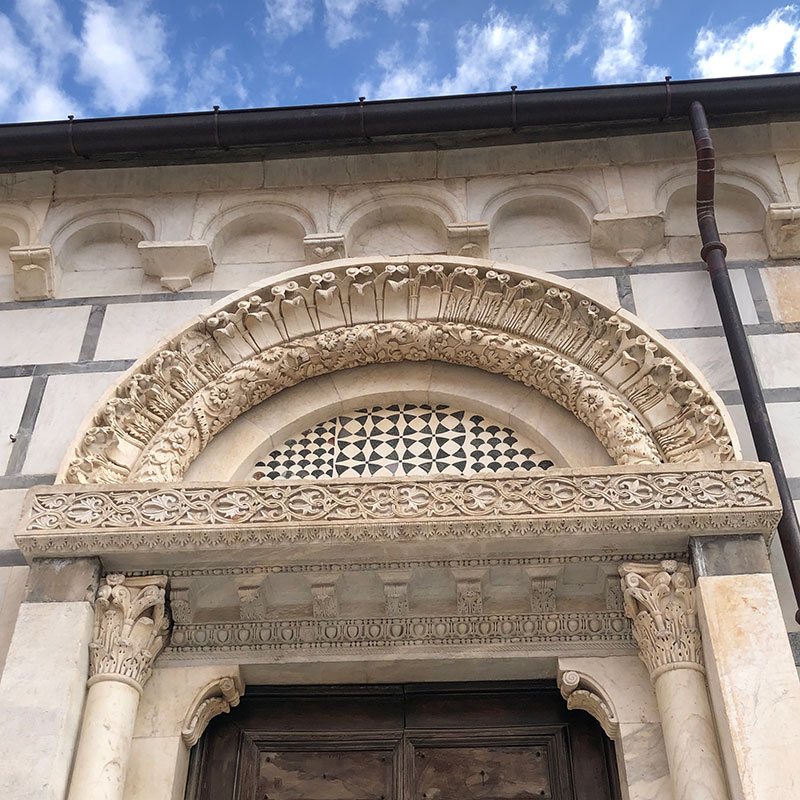
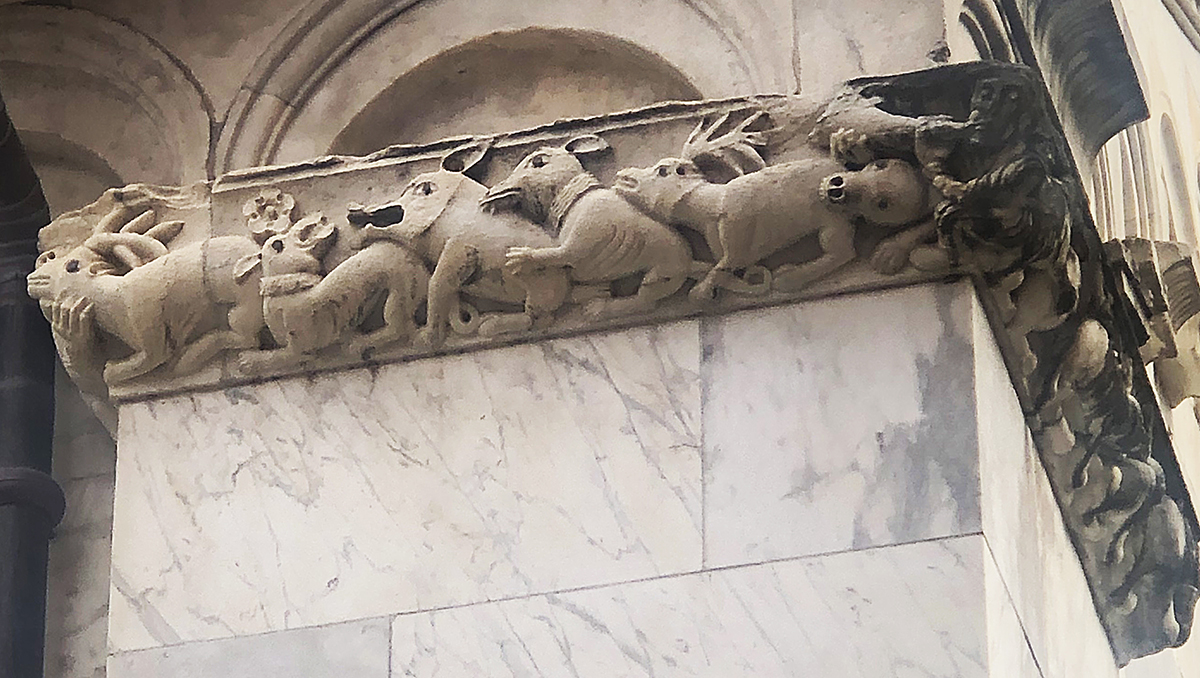
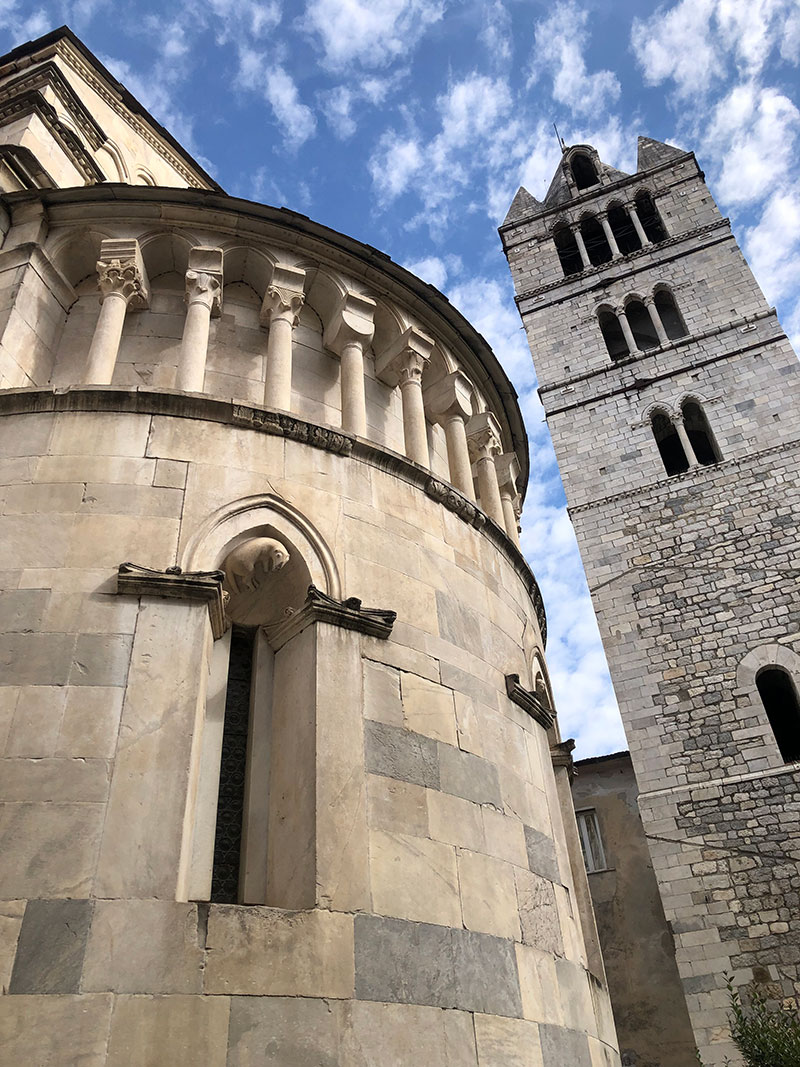
It opens onto the overlooking Piazza Duomo, once called “drent” in the local dialect, an expression indicating how much the inhabitants felt the centrality of the Duomo, as the most important pearl to be guarded. In this façade one can find the portal known as the San Giovanni portal, a few decades more recent than the main one; of Lombard design, it is one of the oldest examples of this architecture in the entire region, even the inlay of the lunette, perhaps marble of ancient reuse, is an essential and important element. As in the interior, the nave is decorated with medieval elements that recall primitive messages, such as the superiority of good over evil, in the eagle seizing the hare or the man with the dog on a leash, in the lunette of the single lancet window and hunting in the capital that opens the view to the apse (photo below).
The apse
The last part of the cathedral to be built is the apse, completed in the XIV century, and harmoniously connected with the rest of the abbey complex consisting of the bell tower, Great Company and Baptistery and the Rectory.
In the apse area, the backs of the two side aisles bear Gothic rampant arches on corbels, which surmount a well ornamented, but closed Gothic window. The central part of the apse, on the other hand, is formed by small arches resting on small columns that admirably crown the upper part of the figures carved under the pointed arch of the three single-lancet windows, the first of which bears an animal of uncertain identification, probably a ram with truncated central horns.
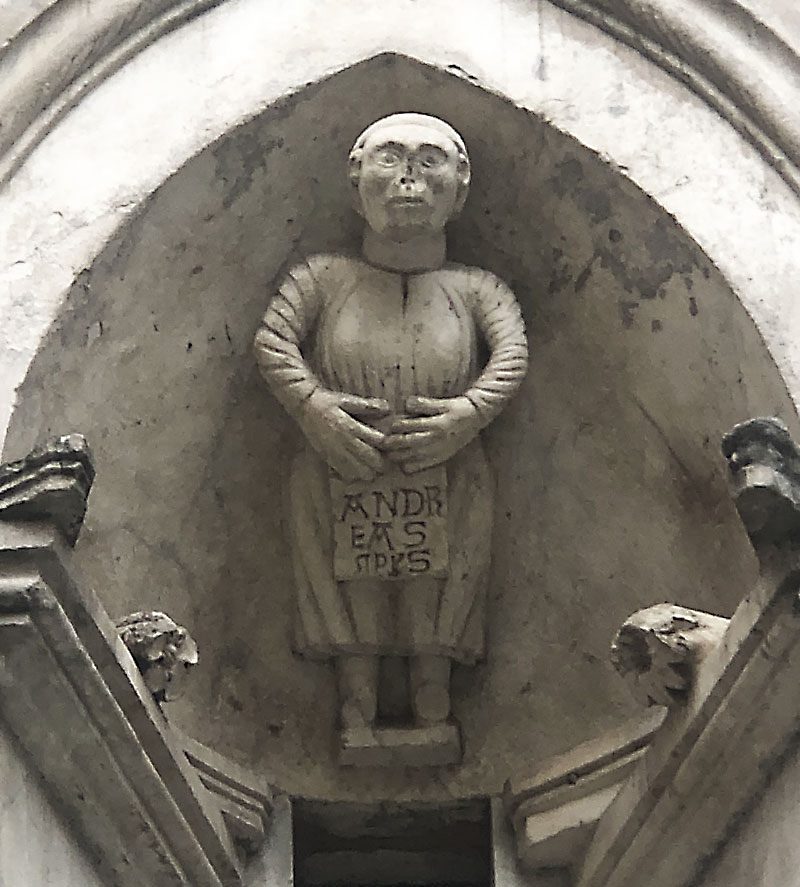
The central one is one of the most interesting of the entire abbey complex and at the same time one of the most controversial. In the relief we find a human figure holding a scroll with an inscription that is for the most part clearly legible, but with two letters that have not been clearly deciphered, giving rise to various interpretations as to the meaning of the phrase; for some, it would be the name of Andrea Pisano, a sculptor and architect from Pisa who may have worked on the construction of the cathedral in the latter part of his life. However, most scholars believe that the hypothesis that the inscription is none other than the wording Saint Andrew the Apostle, owner of the Abbey, is more reliable.
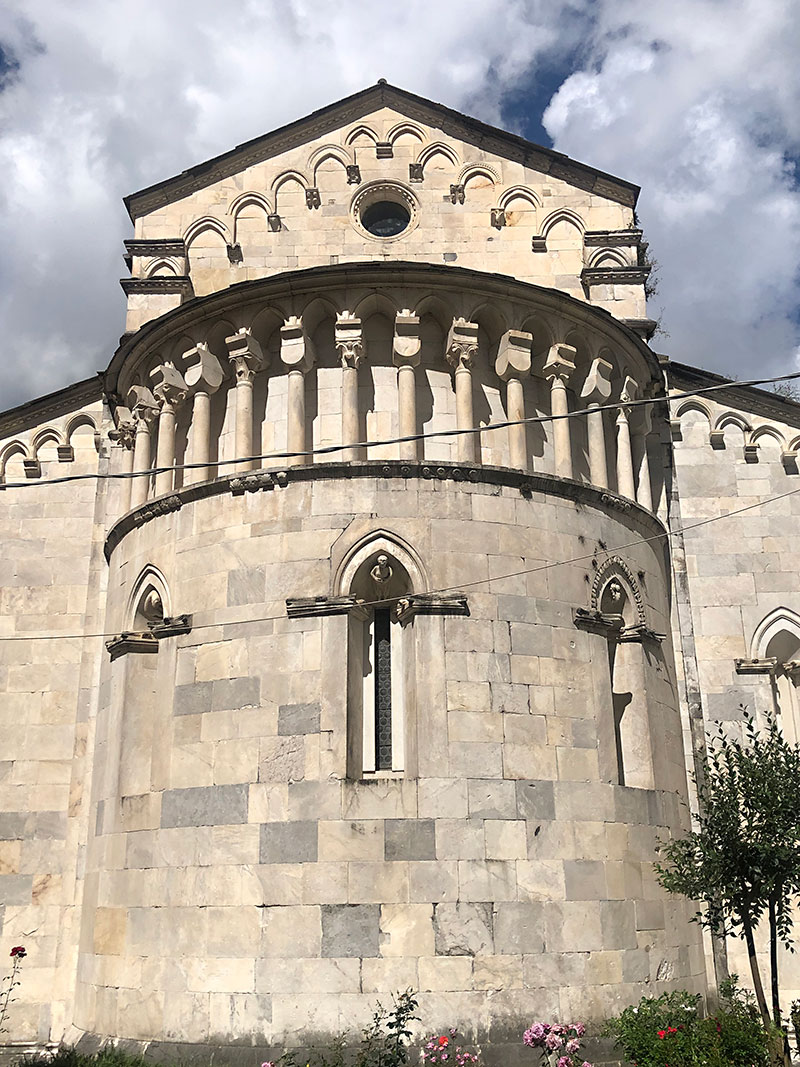
The apse is semicircular in shape. A loggia runs along its outer perimeter, separated from the lower part by a cornice decorated with floral motifs and zoomorphic figures. From the cornice branch off the small columns that terminate at the top with capitals of different sizes and shapes, some with leaf decorations, others with predominantly geometric shapes. Above the small columns we find small pointed arches that closely resemble the composite construction system of Emilia-Lombardy.
A curiosity is found to the left of the eye of the nave in the first three Gothic small arches on the left. Here in fact, starting from the top, we find carved in bas-relief a cross, a wagon wheel and in the third four figures that seem to complement each other: two lateral lilies with a rooster in the centre whose tail forms with the left lily a human profile.
Some details of the stringcourse between the loggia and the lower part of the apse show floral decorations and monstrous representations intended to ward off evil influences or exorcise man’s sinful spirits.
Flowers have always been inspirational in both art and literature. In our case, the cathedral is abundantly adorned with rose-like decorations called rosettes.
The rose is in fact a symbol of female beauty and also of its transience in time.
The north side of the cathedral is perhaps the least visible to the public as it remains delimited between the sacristy building and that of the Compagnia Grande and the Baptistery. It is architecturally similar to that of the piazza, although less adorned with iconographic representations. On the lower part of the outer face of the north aisle, between the door connecting the cathedral to the Compagnia Grande – Baptistery, and the closed door facing the cloister, there are geometric signs such as lines, semicircles circles most likely used by the builders by the workers who tested, measured and assembled the individual parts of the building here before bringing them up to make up the façades.
the cathedral with the baptistery and the rooms of the Sacristy, has a passageway leading to the crypt, a vast room still to be investigated and studied, which among other things contains the mortal remains of the first director of the Academy of Fine Arts, Abbot Canon Antonio Cibej.
The north-eastern part of the area is elegantly completed by the interesting life-size representation of the Holy Family, made with marble donated by the Canalgrande Quarrymen’s Cooperative, the work of French sculptors Cristian Ibanes and Raphaelle Duval from the Menconi studio in Carrara and acquired by the Collegiate Church of St. Andrew in 2013.