
Wall painting
Inside the Cathedral there are some frescos going back to the XV and XVI centuries, all of them are still in their original position and nearly all of them are in a poor condition: colors often undistinguishable, faded shapes and damaged descriptions, in most cases, do not make it possible to identify or interpret them.
These wall paintings were revived during the restoration of 1947/48. A large part of these had been covered by altars built in a later period (consider that during this restoration works; six altars were removed in order to return the temple to its original structure and internal features).
The frescos are visible mostly on the walls of the two lateral aisles, both on the right and on the left, some on them on the rectangular right pillar of the nave next to the presbytery.
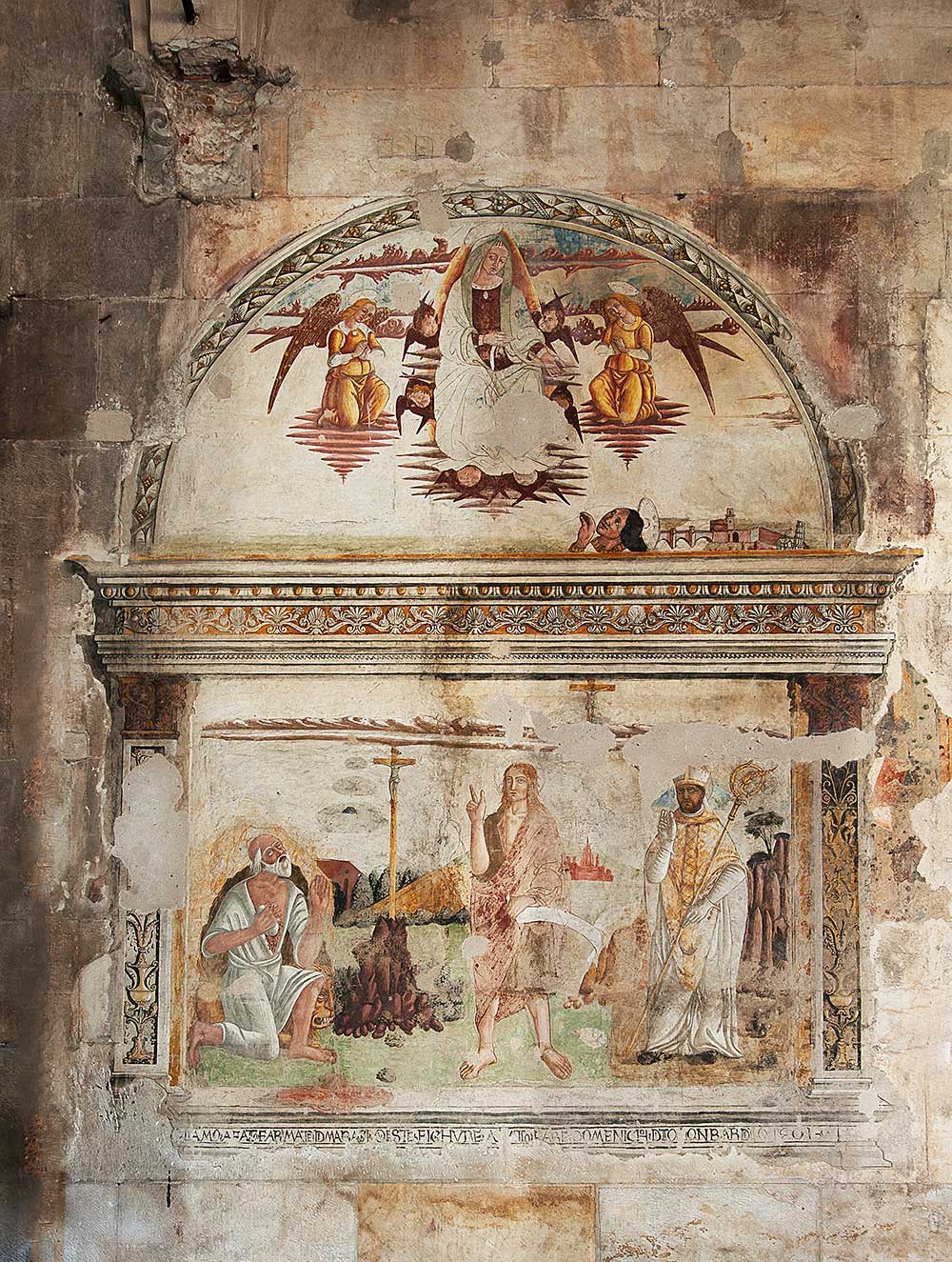
Inside the right aisle of St Andrew the Apostle Cathedral, immediately after the side door of the building, we can admire a wall painting showing the Virgin of the girdle and Saints. It is a sort of “altarpiece”: the central box depicts St Gerolamo, St John the Baptist and St Nicola di Bari.. The following inscription is found below the main box of this work: “…(O)LAMO A FATTO FARE MATE DI MARASI QVESTE FIGHVRE A FATTO FARE DOMENICHO DETTO LOMBARDETTO – 1501”.
In the lunetta, the Virgin is depicted handing the girdle to the doubting St Thomas the Apostle. In fact, through a closer analysis of the painting it is possible to catch sight of a trace of the girdle in the hands of Mary.
In the Legenda aurea of the Dominican Iacopo da Varazze (1228 ca. – 1298), the episode of the offering of the girdle to the apostle is described:
Thomas, though, he wasn’t present [at the Assumption of the Virgin], didn’t want to believe what he had been told. On his return, the girdle that had been around the body of the Virgin suddenly came to him, so that he realized that she had been assumed entirely into heaven.
But why is Pisa depicted behind the Saint? Today, after accurate research and many interpretations of this work, we can state that the devotion to the “girdle” of the Virgin Mary is deeply connected to Pisa. It was in this city, in fact, that between the end of the sixth and the beginning of the seventh decade of the XIII century, the making started of a great votive girdle that would tie all around the Cathedral in honor of the Virgin, to whom the church is dedicated. It was a white fabric band, 365 meters long and decorated by many silver, pearl and enamel tiles, that was hung on nails, still visible today, on the external walls of the Pisan Cathedral.
The wall painting in the Cathedral of Carrara is part of the restoration of this important Marian devotion connected to the Assumption of Mary. St Gerolamo, St John the Baptist and St Nicola da Bari, depicted in the central box of the artwork, represent excellent models of charity, penance and mortification, fundamental features of a devotee that sets out on a pilgrimage. Right in front St John’s door was an important road that led to the Hospitale dedicated to St James and Christopher. This last institution was situated on the path that took the pilgrim towards the inner Lunigiana and Liguria, thus bypassing the dangerous Luni plain.
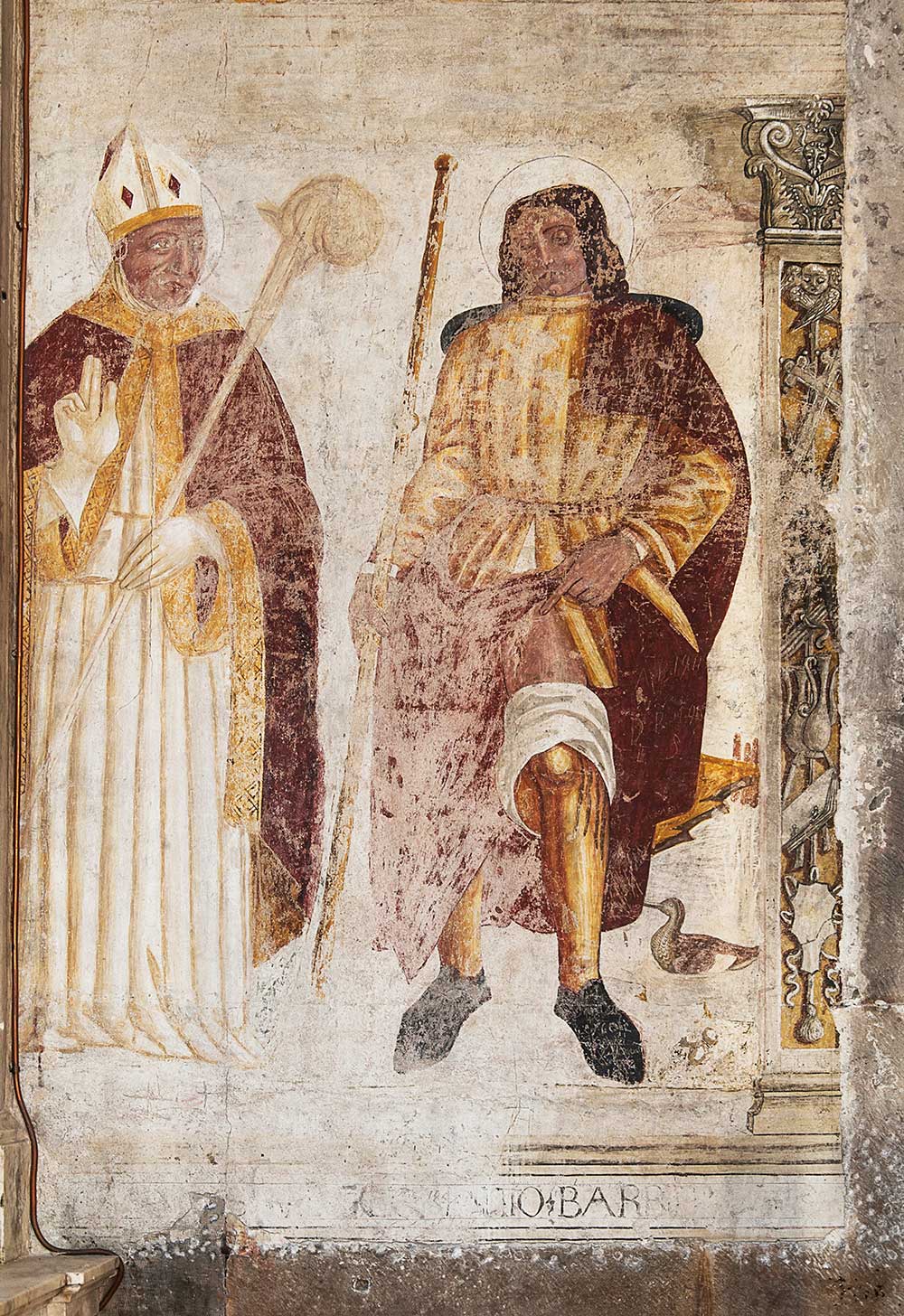
On the right of The Altar of St Ceccardo, two figures of Saints inscribed in two classical themed frames simulating architectural structures, one shows St Ceccardo Bishop and Martyr and the other St Rocco with bleeding sores on his left thigh. The colors that are left are the red of the mantels and the yellow of the garments. Underneath, is a faded writing: O.S.R.-FE-FLORENTIO-BARR……
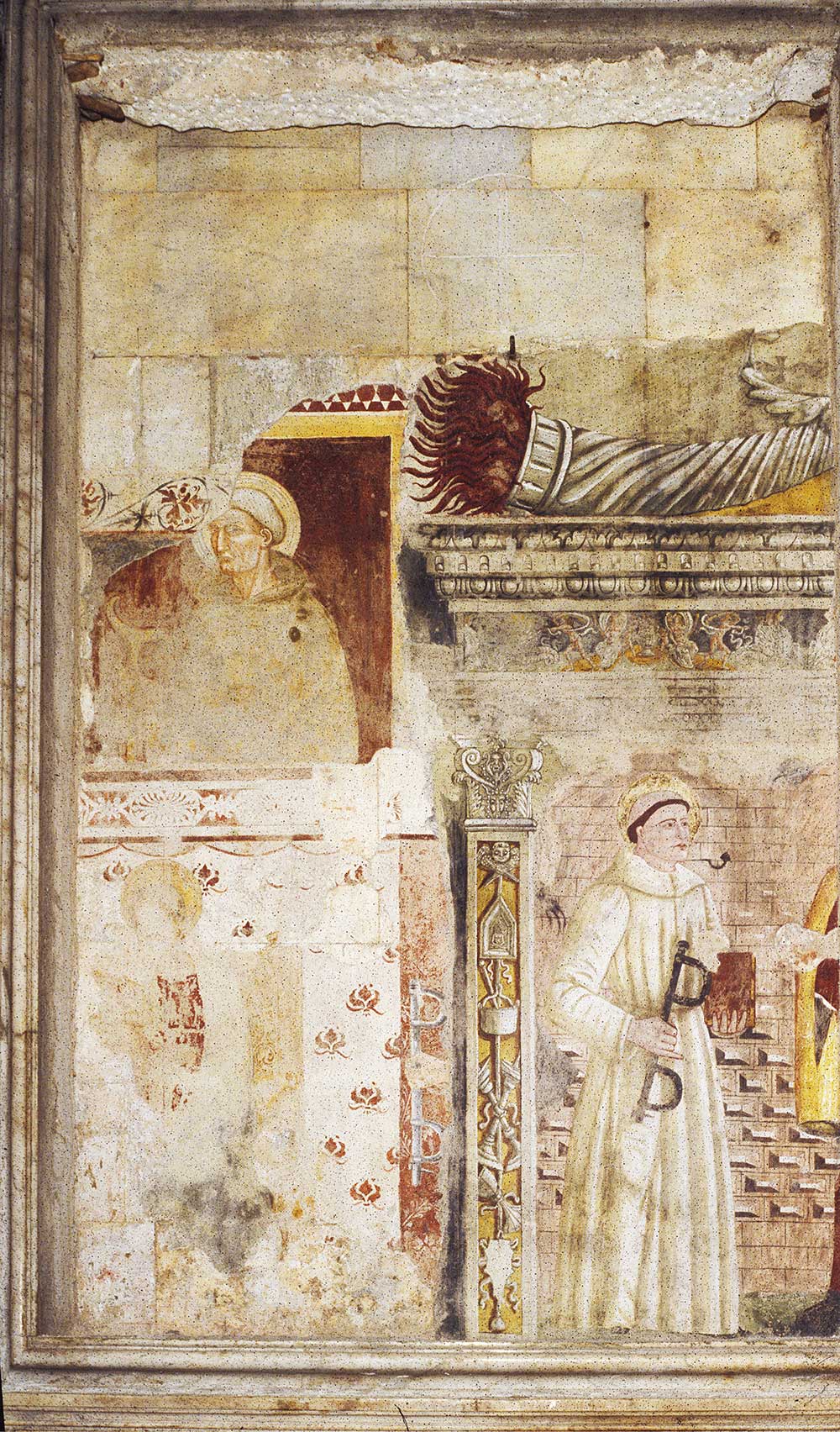
Behind the canvas of The Altar of St Ceccardo (that can be removed only with the permission of the priest), the rest of the fresco can be admired, with the image of St Leonard from Noblat. Furthermore, an earlier fresco depicting St Bernardino da Siena is present. Behind the canvas, below, there are still traces of a very antique image representing the Virgin and Child.
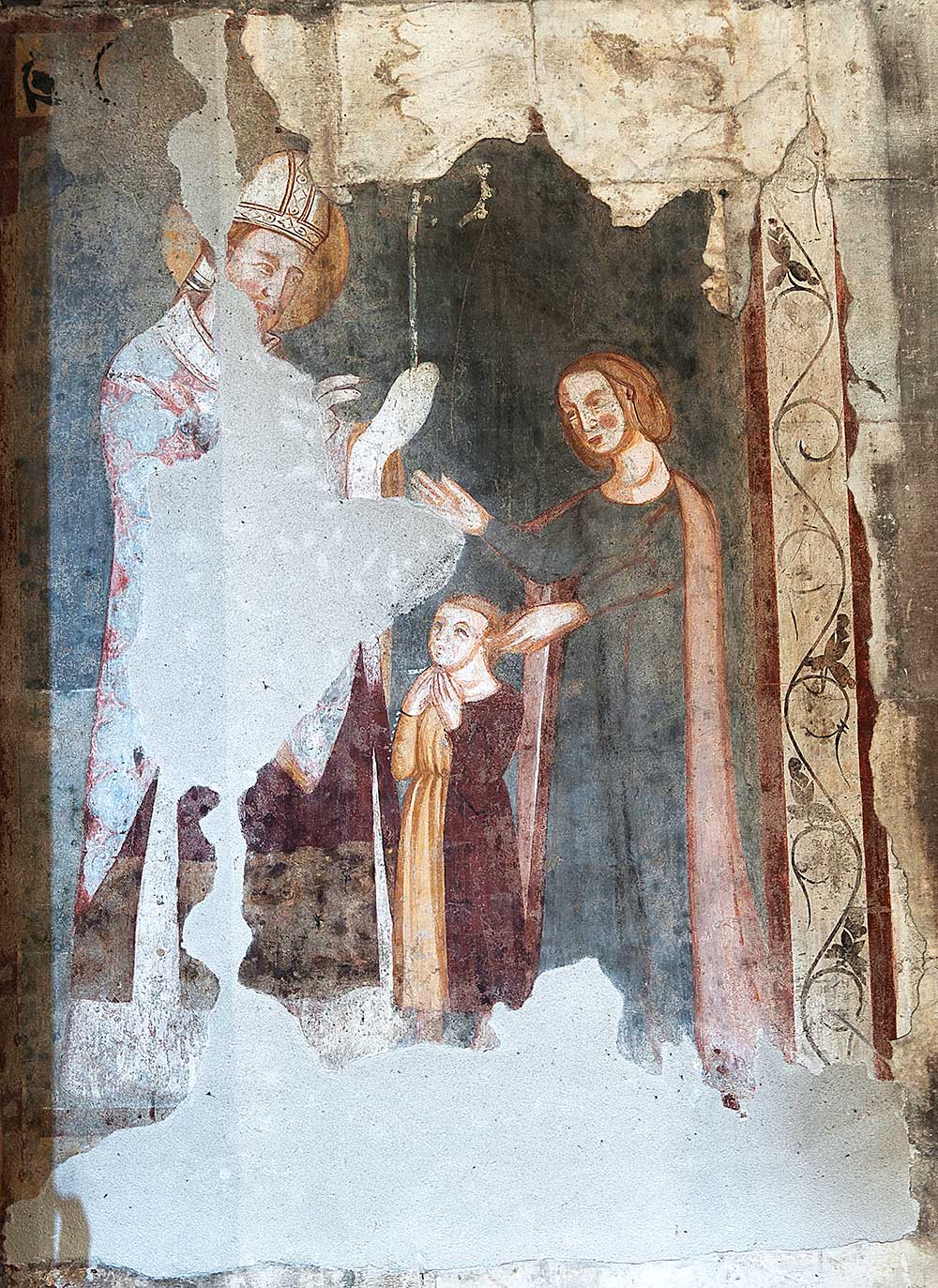
Along the same aisle, after the marble sarcophagus of St Ceccardo, in a box with a decorated frame, a scene that could be the presentation of Mary to the temple is depicted: on the left, the priest in Bishop garments, in the center, Mary as a child and, on the right, the mother Ann (work by an unknown artist). It could also be the miracle of St Blaise that frees from the fishbone.
On the right rectangular pillar of the nave, next to presbytery, underneath the monogram of Jesus (YHS), a Saint is depicted with a mantel and halo, some say it’s St Onuphrius the Anchorite, by an unknown artist. On the internal side of the same pillar, a Prophet is depicted (unknown artist) and some angels. The paintings are for the most part identifiable.
Going down the opposite aisle, we encounter, after the Marble Group described in Chart N# 11, a painting at the base of which the following can be read with great difficulty:
FACTVM IMPENSA S.P.A…. CARPATIA
A.D. MCCCCCI… IULIS
Slightly further on, in two classical themed frames simulating architectural structures, two Saints not fully identifiable are represented: the one on the left, has a short tunic of undecipherable colors, the one on right holding a stick, has a red garment and yellow drape (unknown artist).
– Finally, after The Altar of the Virgin of the People, a very incomplete fresco, so much that in many areas the sinopia is visible, it represents the image of St Blaise in faded red and yellow pontifical garments flanked by a saint with an halo (maybe St Antonio Abate), and it is in a rectangular frame. On the left, you can see the haloed head of another Saint in a white tunic (St Leonard or St Sebastian). This painting, by an unknown artist, is very damaged.