
Company of the Blessed Sacrament and Baptistery
This is how the antique Baptistery is called, after the name of a confraternity, the Company of the Blessed Sacrament, that had its seat here. It is divided in two parts: A) on the right (entering from the Cathedral), the Chapel of the Rosary, inside which the altar also called “of the Redemption” is found, B) on the left, the actual Baptistery.
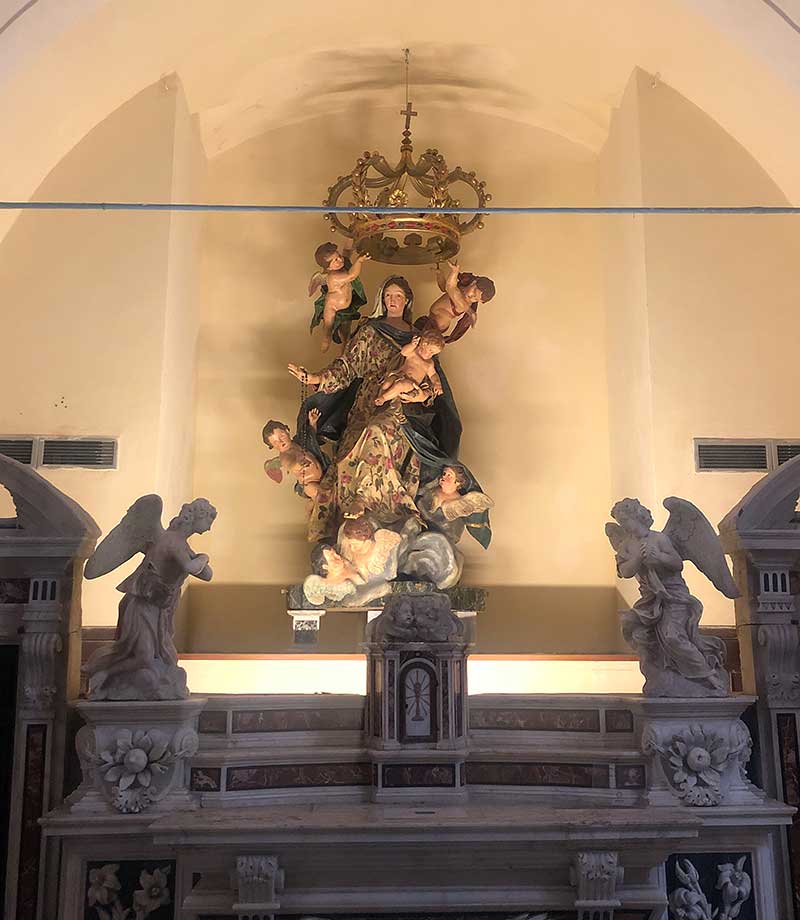
A – Chapel of the Rosary and altar “of the Redemption” (XVIII century)
On the sides of the Great Altar, in eighteenth-century style, are two Statuario marble angels in adoration; behind the altar, in a big niche, an Our Lady of the Rosary made of papier-mâché from the second half of the XVIII century. The artwork is attributed to Giovanni Antonio Cybei, first director of the Academy of Fine Arts of Carrara. In the past, the sacred image was carried in procession through the streets of the city.
In front of the entrance door, placed against the wall, is the altar called “of the Redemption”, this too an artwork by Giovanni Antonio Cybei and his workshop. The altar owes its name to the Redemption Institution founded by Felice Valesi, the aim of which was to free slaves. On the white altarpiece, with an abundance and variety of marbles, there is the scene of an angel blessing two slaves on their knees. Below are St John de Mata, doctor of Paris, and the anchorite founder of the said Institution, both kneeling on the clouds. Above is the Holy Trinity. In the frontal, underneath the table, a deer is depicted, a clear reference to Psalm 41: “Sicut cervus desiderat ad fontes aquarum / ita desiderat anima mea ad te, Deus “ (As the deer longs for water springs, so my soul longs for you, God”)
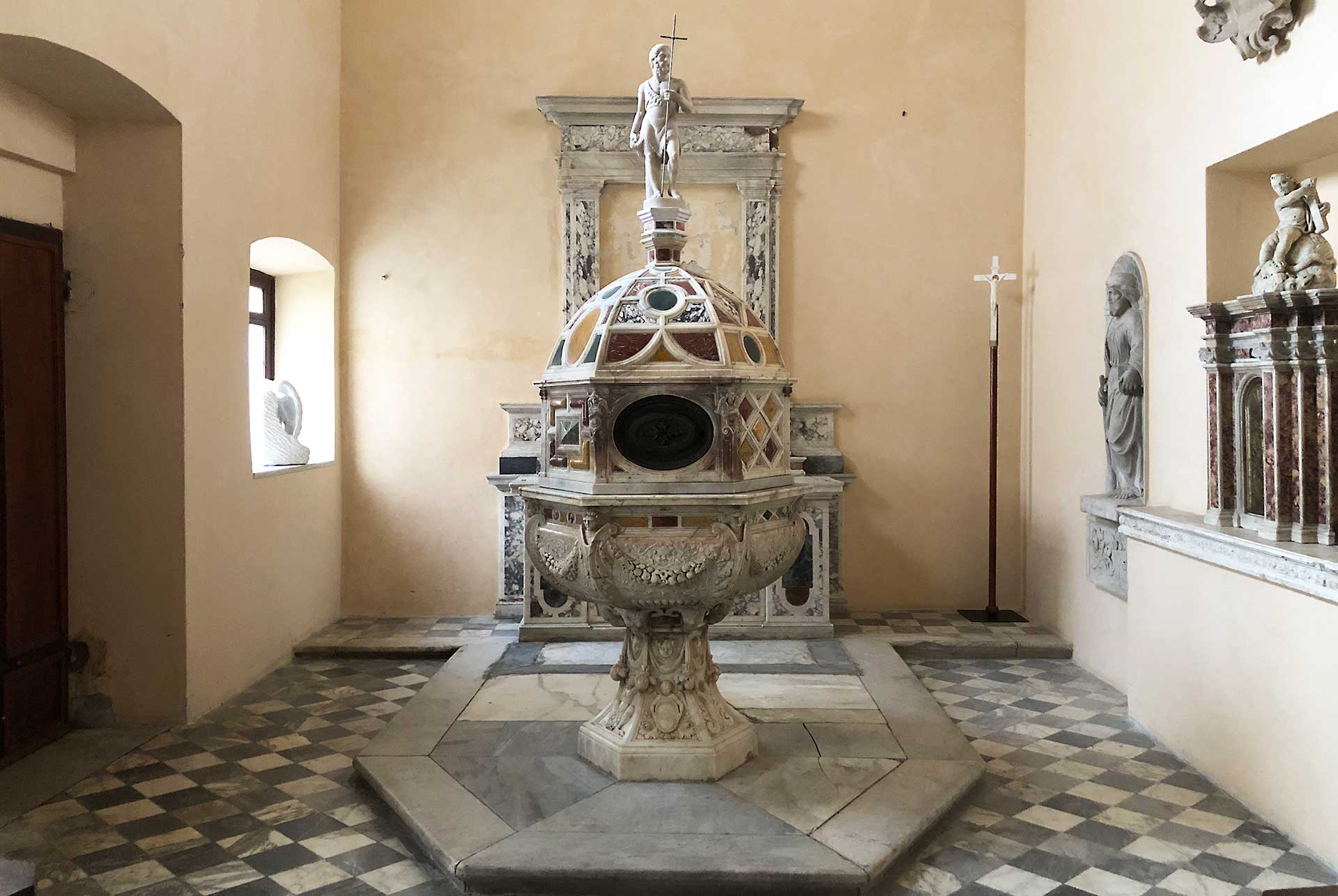
B – Baptistery
At the back of the Baptistery, there is an altar in which an ancient baptismal font is incorporated. It is an authentic jewel of Renaissance craftsmanship, built in the shape of a chalice, finely chiseled with fruit and leaves. On one side, the face of Baccus is represented, following the trend of the time of revisiting pagan myths from a Christian viewpoint.
At the side of the font, is the great tabernacle (XVI century) that in the past was kept on the Greater Altar of the Cathedral