Altar of the Blessed Sacrament
XVI century
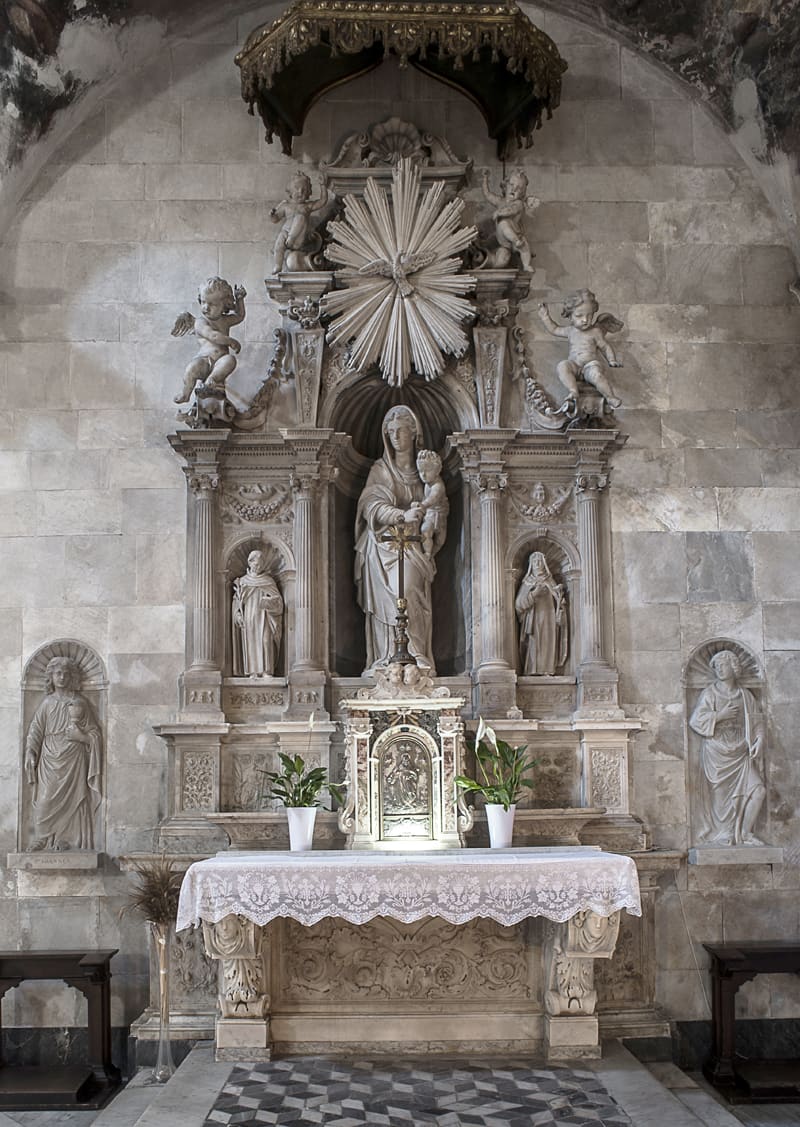
The original altar, very similar in style to the Great Altar, is by Domenico del Sarto and Giovan Battista del Mastro, two artists from Carrara. Elements of different epochs and styles were added in later periods.
Underneath the table, is the finely decorated frontal between two supports with caryatids of the XVII century. The Virgin with Child is by Clemente da Reggio. The two smaller statues, on the sides, depict St Dominic, on the left, and St Caterina da Siena, on the right. In the lower part of the altar, on the sides of the tabernacle, you can admire two small marble tiles depicting St Orsola Martyr (on the left) and the Virgin with Child and St Antony from Padua (on the right). On the sides of the altar there are high reliefs of St John Evangelist (on the left) and St Thomas Apostle (on the right). On the vault, the fresco of the roman painter Aquilio or Acquilino Bernardino depicts the Assumption of the Virgin, with four Evangelists at its base (sec. XVIII century).
The fresco
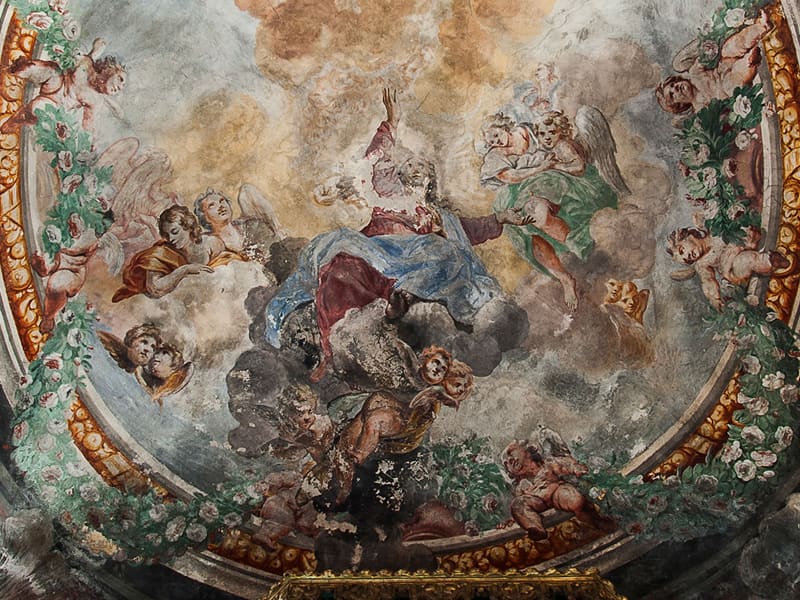
The fresco dedicated to the Assumption is located in the vault above the 16th-century altar of the Blessed Sacrament. The fresco work is commonly attributed to the Roman painter Bernardino Aquilio, also known as Aquilino Romano. However, Campori’s Memoirs show that the paintings, executed in 1547 by Bernardino for the Company of the Body of Christ of Carrara Cathedral, were in another position, because they were described as ‘(…) reduced to a very bad state, they were covered by a wall of coloured marble in 1856’. Canon Pietro Andrei recalls that the frescoes depicted the prophets Isaiah and Ezekiel, which were covered by the embellishments in the Chapel of the Blessed Sacrament in 1856. Count Lazzoni also wrote in 1880 that: “The aforementioned altar is located at the top of the left aisle, within a chapel rich in Carrara and foreign marbles on the walls, a design, as far as that compartment is concerned, not too happy by prof. In the ceiling, we can admire a fresco painting of the Assumption of the Virgin, with four Evangelists on the impost of the vault, the work of the Roman painter Aquilio Bernardino, completed by him in July 1548; however, the walls, also by the same artist, were reduced to a poor state of repair and in 1856 were covered by a wall of coloured marble with statues, as already mentioned above”.
The fresco on the vault, in fact, presents peculiarities typical of the Baroque period, a long way from the Roman painter’s stay in Carrara: in fact, the Virgin seated in heaven seems to recall similar works by Pietro da Cortona. Bernardino’s frescoes were probably located around the altar of the Holy Sacrament, modelled on the corresponding altar of the Assumption at the end of the other nave of the Cathedral.
Altar of the Assumption
XVI century
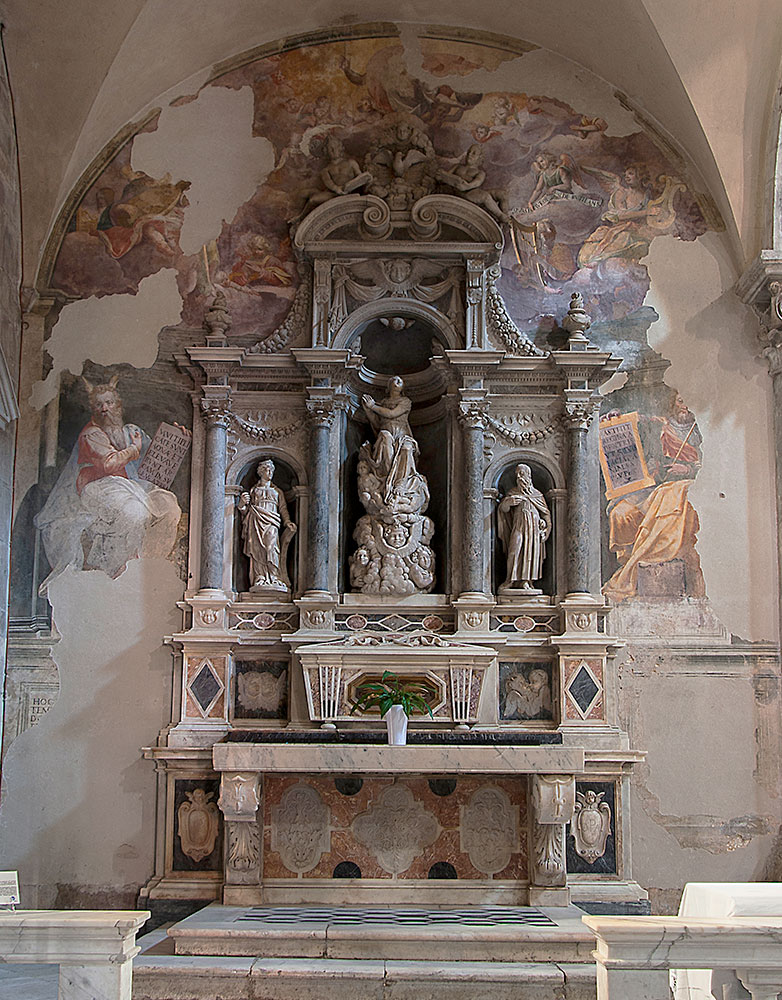
Designed by the Carrarese sculptor and architect Andrea Pelliccia, the altar was built by the two Carraresi Andrea di Tomeo and Francesco Bergamini and by the artist from Messina, Rinaldo Bonanno. The central statue of the Virgin is attributed to “Moschino”. The lateral statues, of an unknown artist, depict St Catherine from Alessandria (on the left), where you can see the wheel of torture, and St Bernard (on the right). In the sarcophagus on the table of the altar, there are the relics of the Martyr Saints Innocenzo and Victoria.
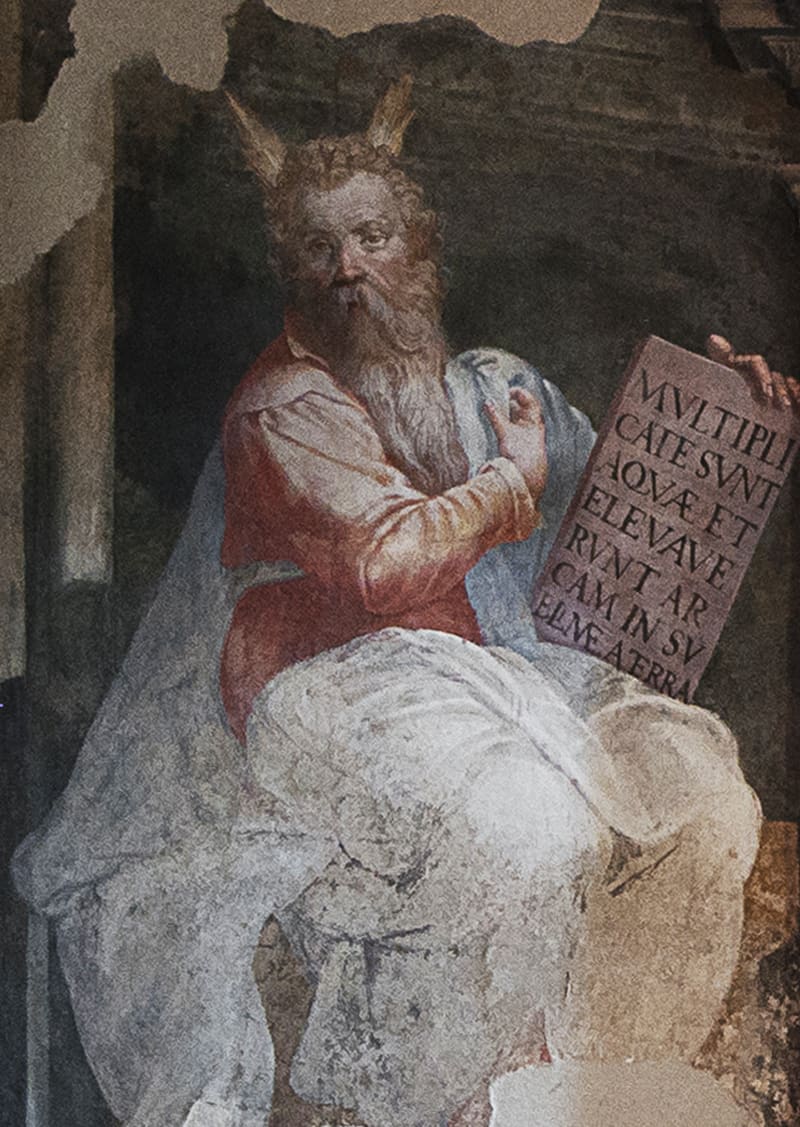
The paintings on the wall depict David with the Book of Psalms and the sceptre, wrapped in a draped mantel of an indecipherable color on the right, and, on the left, Moses, in a draped gown, with the book of Genesis open on the words:
MVLTIPLI/CATE SVNT/ACQUÆ ET/ELEVAVE/RVNT AR/CAM IN SV/BLIME A TERRA.
These paintings were part of a larger fresco at the center of which was the Assumption of Mary into Heaven among the angels, still visible in the upper parts, with citharas and festoons with verses from the Book of Wisdom praying the Virgin.